Teachers' Resources | Heritage in Schools Skip to main content

Teachers' Resources

Teach your pupils how to build a giant nest, create a butterfly garden or make their own family tree!

The resources provided here have been submitted by Heritage Experts, teachers or prepared by other educational organisations. The resources are both fun and educational and are designed to inspire and develop an appreciation and curiosity about Ireland’s wonderful natural and cultural heritage.

Resources can be searched for under the following categories:

Notice Nature

Science

Notice Nature is Ireland's public awareness campaign on biodiversity which aims to raise awareness of the importance of biodiversity and to encourage everyone to play their part in its protection. Their website has a great resource section for children which includes live animal web-cams, posters, information, games and puzzles.

My First Book Of Irish Animals

Science

My First Book of Irish Animals is written by our very own Heritage Expert, Juanita Browne! The book is aimed at introducing young children to the wonderful world of Irish wildlife.  Filled with fascinating facts and beautiful illustrations by Irish artist, Aoife Quinn, this book will capture the imagination of young children.

The book includes a range of Irish species, such as the red squirrel, hedgehog, pygmy shrew, rabbit, Irish mountain hare, Irish stoat, pine marten, red fox, and the various species of deer, bats, seals, whales and dolphins. There is also a section on tips to support wildlife and to help your pupils connect with nature.

Also, your purchase supports Irish wildlife, for each copy sold, the Irish Wildlife Trust will receive a commission from Juanita.  The book costs €9.99, plus €2.50 doe postage and packaging.

My Book Of Kells Colouring Book

History

The Book of Kells is the most famous hand-coloured book in the world. This great publication gives you the chance to colour some of the drawings as the monks did over a thousand years ago. Choose from over 60 drawings of heavenly figures, Biblicial characters, fantastic creatures, animal and bird designs and Celtic lettering - to create your own little masterpieces.

Make A Concertina Book

Science, History, Geography

This book is quick and easy to make, yet still offers flexibility and potential for children to create their own unique versions. They can be used for everything from storytelling to making guidebooks about a local wood or museum, what they put into your book is up to you!

Nature Activity Guides

Science

Pupils can bring these handy little sheets out and about with them on their nature walks, encouraging them to engage with the environment around them. Activities include Bird Food Bingo, Leaf Hunting Sheet and Wild-Day Out.

Little Monsters

Science

Bugs! In all shapes and sizes, big ones, small ones, long one, tall ones, slow ones, quick ones, with over 1 million known species, it’s time we got to know our neighbours a little better.

Use this task to develop the children’s awareness of these little critters and the great job they do in keeping our ecosystem going: pollinating flowers and crops, aerating and nourishing the soil, providing food for other wildlife and generally maintaining the balance of nature. It also introduces the children to bugs and insects in a non-threatening manner.

Things To do
1.    Find little monsters! Download the Little Monsters worksheet below and bring the children out to the school grounds or local park and ask them to find (but not touch!) the insects and bugs on the sheet.

Leaves and Trees

Science

Trees are more than just a place for birds to rest! They give air, food, shelter, warmth. It may look like trees just stand around and do nothing. Actually, they are very busy doing a variety of jobs that are essential to animals and the environment.

Things To do
1.    A nature ramble to the local park to collect different types of leaves and see if the children can match them to the Leaf Hunt worksheet below or if this not possible bring in some leaves and see if the children can match them.
2.    Repeat this exercise in all four seasons and explain the differences in the colours and shapes
3.    Take part in National Tree Week and plant a tree in the school grounds.

Kinderart

History

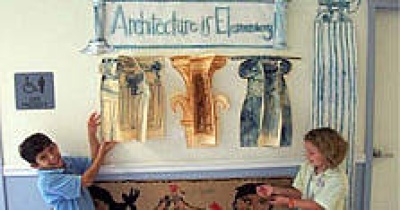
Fun ideas for hands-on architectural projects for 8-12 year olds, including building a paper 'pet-house' and different styles of architectural columns.

Learning In The Outdoors: Research By Natural England (2012)

Research and Policy

The UK's Natural Environment White Paper - The Natural Choice: Securing the Value of Nature sets out the need to strengthen the connection between people and nature, and gives an explicit call for every child in England to be given the opportunity to experience and learn about the natural environment.

To help achieve this ambition, the UK Government sets out several key reforms which include a commitment to removing challenges and increasing teachers' and schools' abilities to teach outdoors. It is within this context that Natural England undertook the following three pieces of research which explore different aspects relating to outdoor education.

Kilkenny's Medieval Churches

Science, History

There are several medieval churches still to be seen in Kilkenny City. St. Canice’s Cathedral is the most complete. It is called a cathedral because it was built as the principal church of the diocese. It was the special church of the Bishop of Ossory and he had his seat there. This was an actual chair which was called cathedra in Latin. St. Mary’s Church was the Parish Church of Kilkenny in the middle ages

There were three churches which belonged to religious orders: The Black Abbey was part of the Dominican Priory. Besides the church which you can see today, there were lots of other buildings where the priests and lay brothers lived and worked. It also owned some land and had a mill on the river Bregagh. It lay outside the walls of Kilkenny, but was connected to the rest of Kilkenny by a gate. St. Francis Abbey was a Franciscan Friary. Part of its church can be seen from the main gate of Smithwick’s Brewery. This is only part of the original church and there were other buildings, now gone.

Franciscans and Dominicans were known as Mendicant Orders. A mendicant is someone who begs. The mendicant orders were founded to preach the gospel and to serve the poor. Instead of living off the produce of land which they owned, the Mendicant Orders got much of their income from the ordinary people. St. John’s Priory was an Augustinian priory. It was also the Parish Church of St. John’s Parish on the east bank of the River Nore.

Download the information sheets below to find out more about Kilkenny’s Medieval churches.

Kilkenny Water

Science, History, Geography

The city of Kilkenny is built on the River Nore. The name 'Nore' in Irish is An Fheoir, which probably means the boundary. The river rises far to the north in the Slieve Bloom Mountains between counties Laois and Offaly. The monastery, cathedral and small town which existed before the Norman invasion was built on the west bank of the river. Today the Nore is crossed by three bridges – Green’s Bridge, John’s Bridge and Ossory Bridge.

Download the resources below to explore the history, science and geography relating to Kilkenny’s water.

iSPY Nature

Science

iSPY Nature aims to encourage young Irish people to get involved with nature and wildlife. Apart from providing a great range of photos, resources and project ideas, users can record their own wildlife sightings and notes on the interactive site.

How To Attract Bees!

Science

Why not plant some clover or other plants that will attract bumble bees into the school garden? There are lots of other tips and tricks for turning your school garden in to a ‘hive of activity’ on the website too! 

Holding Out For A Hero

History

Irish history has a cast of millions of characters, but every now and then one lad or lady sticks out as truly heroic. It’s time for Neil Delamere to take on Ireland’s Heroes. From the legendary warrior, Cúchulainn to the pirate queen, Gráinne Mhaol, Neil wants to get inside their skin and see if he has what it takes to be a modern day Irish Hero. Spoiler alert: He doesn’t.

High Crosses

History

A high cross is a free-standing Christian cross made of stone and often richly decorated. They were raised primarily in Ireland and Britain during the Early Middle Ages and sometimes later. They often, though not always, feature a stone ring around the intersection, forming a Celtic Christian cross.

Things To do
1.    Download the High Cross worksheet below and ask the children to design their own high cross, maybe using symbols that are in use today.

Grow Your Own Name Initials

Science

Fun for younger age groups with simple, step-by-step instructions for growing the first letter of a child's name using corn seed!

From Apathy To Empathy: Reconnecting People & Place Symposium

General, Research and Policy

A symposium with leading international and national experts in place-based education took place in August 2012 in Kinvara, Co. Galway. This unique event brought together thinkers and practitioners who specialise in the theme of place-based learning, which encourages the use of the local environment as a learning resource. Feedback from organisers, speakers and attendees is available to listen to on Sound Cloud.