


Dáithí at the Rocky Seashore: Martina Butler
This tutorial shows younger children a little about some of the typical species that can be found in rock pools at the rocky sea shore.
Suited to children from junior to 1st classes.
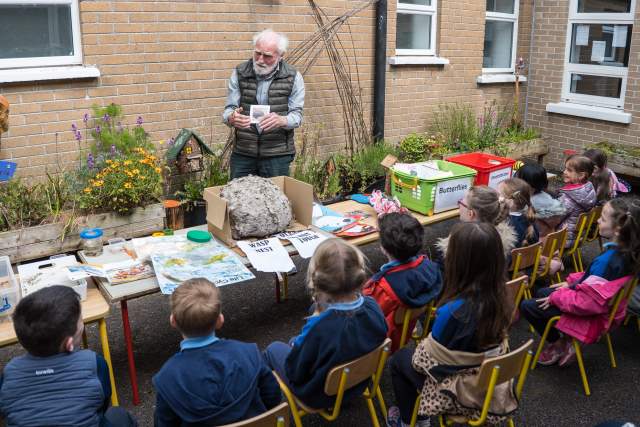
Teach your pupils how to build a giant nest, create a butterfly garden or make their own family tree!
The resources provided here have been submitted by Heritage Experts, teachers or prepared by other educational organisations. The resources are both fun and educational and are designed to inspire and develop an appreciation and curiosity about Ireland’s wonderful natural and cultural heritage.
Resources can be searched for under the following categories:
This tutorial shows younger children a little about some of the typical species that can be found in rock pools at the rocky sea shore.
Suited to children from junior to 1st classes.
Legend has it that two different types of beetle once fought over a juicy slug, but all may not have been as it seemed. Learn about the ecology and anatomy of ground beetles and the devil's coach horse beetle.
Suited to children from 1st to 4th classes.
Moths are attracted by the scent of fermenting fruit. You can make up a sugary treat for moths. There are many different recipes and why mot experiment - Albert shares his receipe here.
A booklet to assist everyone to help wildlife in their gardens. The brainchild of Juanita Browne, the booklet was produced by Laois County Council with the assistance of Local Authority Heritage Officers across Ireland, with support from the National Parks and Wildlife Service and the Heritage Council.
Read moreRead lessTaking a very practical approach, the book details projects to help wildlife of all kinds under a range of headings, with tasks suitable for everyone from the total beginner to the more ambitious DIY enthusiast. With clear instructions and step-by-step drawings by illustrator Barry Reynolds, the guide offers the gardener lots of options to help our biodiversity.
A colouring book for children using the beautiful garden wildlife illustrations by Barry Reynolds has also been produced.
A pollinator newsletter for children on Protecting Farmland Pollinators. Learn about Pollinator Science, History and Geography with games, puzzles, art and competitions.
Read moreRead lessAn introduction to some of the fish species found around the Irish Coast. Design and drawings by Carmel T. Madigan.
Join Eanna Ní Lamhna, as she takes you on a journey exploring the native trees of Ireland.
This film was produced in cooperation with Orla Farrell of Easy Treesie.
Read moreRead lessEasy Treesie's goal is for every child in Ireland to plant a tree and to sponsor one in the Global South. A million trees by December 2023. Read more at http://easytreesie.weebly.com/...
The Irish Peatland Conservation Council's Education Department has published a wide range of resources to help groups and individuals, teachers and educators learn about bogs and introduce bogs to your classroom.
Read moreRead lessThe resources are copyright free for educational use by teachers with their class group. The materials presented are taken from the Peatland Education Pack published by the IPCC. This publication and other packs, dvd’s, books, charts and pictures can be purchased from our Nature Shop.
Access the resources here: Bogs in the Classroom.
A short animation from the Biodiversity Office of Dun Laoghaire Rathdown County Council which explains Ecosystem Services (Benefits of Biodiversity) in simple terms.
A self-guided handbook for primary school teachers to facilitate the use of local parks as outdoor classrooms. Published by Dublin City Council and an action of the Dublin City Biodiversity Action Plan 2015-2020
Counties Laois, Meath and Monaghan came together with Éanna Ní Lamhna to develop this book and series of worksheets for Primary School teachers called Wild Things at School as a joint project under the County Heritage Plan Scheme.
The Heritage Council co-funded the publications however it does not have hard copies of the publication.
This is the second tale from Dale Treadwell about Robby the Robin's adventures and all the feathered friends he meets along the way as he forages for food in the garden.
Read moreRead lessHard copies they can be obtained through Naturally Wild at €5 each or €8 for two plus postage.
This is the first tale from Dale Treadwell about Harry the Hedgehog as he goes in search of a friend. Join him on his journey!
Read moreRead lessHard copies they can be obtained through Naturally Wild at €5 each or €8 for two plus postage.
A planning guide from the Marine Institute for primary school teachers on ocean literacy and engagement - oceans facts, evaluation tools and ideas for the classroom.
The Explorers Education Programme™ aims to build on Ireland’s marine and maritime heritage by increasing awareness of the value, opportunities and social benefits of our ocean wealth and identity. This ocean literacy and engagement guide provides ocean facts, evaluation tools and ideas for the classroom.
Empowering Teachers and Pupils for a Better Life through Nature - some useful resources for pre-school and primary school teachers.
Read moreRead lessLast July BirdWatch Ireland hosted 60 preschool and primary school teachers for an environmental education training course as part of the Empowering Teachers and Pupils for a Better Life through Nature project, funded under the European Commission’s Erasmus+ programme. These lectures and training sessions were filmed and are available to down load free of charge.
A video on Barn Owls in Ireland from BirdWatch Ireland and sponsored by the Heritage Council.
It’s time to get out of the classroom with the Eco Ranger’s school programme and use active learning with your pupils to discover, learn and connect with nature. Once you’ve registered for Eco Ranger’s offline and have received your confirmation, you can go ahead and register here on the website https://www.ecorangers.ie/.
Read moreRead lessNature and biodiversity is something that Bord na Móna is investing in as part of our day to day work. This is why Bord na Móna created Eco Rangers- Guardians of the Land an initiative for schools that gets children outdoors and connecting with nature and learning about the importance of protecting it. See more at https://www.ecorangers.ie/.
What is Water Explorer?
Water Explorer is a fun, inspiring and educational programme that empowers thousands of students across the world to lead joint action on water issues for their schools and communities. Water Explorer is fully funded and supported in 11 countries and is free to all schools and groups taking part. Top Water Explorer teams could earn the chance to represent their country at the Water Explorer International celebration event in London.
What do Water Explorers achieve? Water Explorer supports 8 -14 year olds on a student-led mission to rescue our waterful world. Water Explorers are supported to:
What impact will Water Explorer have? By the end of the two-year programme (Sep 2016), the programme will have resulted in the following (among other) benefits:
Bat Conservation Ireland has created a fabulous new website for Irish primary schools including Irish bat fact pages with associated worksheets, pages about art and craft activities, a bat presentation that teachers can download for use in the classroom and lots of things to do for Halloween!
Illustrations have been provided by children's author and illustrator Marie-Louise Fitzpatrick.
The website reviewed by primary school teachers.
How Can Schools Help Pollinators?
In 2015 bee experts in Ireland came together to produce the All-Ireland Pollinator Plan 2015-2020. We did this because our pollinators, especially our bees, are in big trouble. We need bees to grow our fruit and veg, and to make sure our countryside has lots of beautiful wildflowers. Now we need your help to make Ireland a better place for bees and other pollinators. We need you to tell everyone how important bees are. We also need you to make your school and garden a safe place for bees to live.
Visit the website of the National Biodiversity Data Centre for more information and guidelines on what schools can do to help pollinators http://www.biodiversityireland...
The Living Classroom is a huge educational resource for schools linking in with 70% of the curriculum.
Read moreRead lessA school garden is a great addition to your school. Children learn and have fun in a natural ever-changing environment where they get to appreciate nature, nutrition, and even how maths, reading, geography and history can be fun and how they fit into and influence our day to day lives. They get to learn in a new and exciting way.
Visit http://www.schoolearthed.ie/li... for a range of ideas, resources and links relating to the school garden.
Outlines what could be done and how in the school garden every month of the school year.
Available for €10.00 (plus €2 p&p) from paddy.madden@mie.ie
Get muddy and run wild!
Read moreRead less
Discover a range of Nature Detectives activities for all ages from the Woodland Trust.
Screw bound and printed full colour on both sides, this is a pocket-sized (85 × 125 mm, W × H) photographic guide to the 35 native and 8 of the more common introduced trees and shrubs in Ireland divided into winter and summer identification. Summer identification is based initially on leaf shape whilst winter identification is based primarily on winter bud structure and arrangement. Published by the National Biodiversity Data Centre and available to purchase at http://www.biodiversityireland....


