
Robin Run The Hedge (All About)
This is a very common hedgerow plant and one that children like very much when they become aware of it. It is an annual plant and grows anew from seeds shed the previous year. It springs up in April and thrives in shady places because it is able to climb up to the light. It can grow up to 2 metres high in the right conditions. It is able to do this because it is covered with minute hooks all over its stem and leaves and these allow it to stick to anything close by and climb up using it as support.
The stems carry the leaves in whorls of six to eight at regular intervals all along the stem. In June, the flowers appear. These occur in tiny white clusters both at the top of the stem and at the leafy whorls along the stem. The seeds are carried in pairs of rounded green balls which occur where the flowers were. These little balls are covered in hook-like bristles that stick to anything that brushes against them. Any passing mouse, fox, bird — not to speak of humans in long trousers — gets thoroughly covered in these sticky balls which are groomed off later, thus spreading the plant.
This method of seed dispersal is particularly effective in wooded areas where there would be very little wind to disperse them. Close examination of the seeds or indeed the leaves with a magnifying glass is well worthwhile as the hooks can be seen. A Swiss naturalist — George de Mestral — did exactly that in 1948 when he noticed that these were all stuck to his clothes after a walk. He noticed the sharp hooks and decided that a fastener to rival a zip could be invented from this. After much trial and error, he manufactured the hooks on a nylon strip and they connected to a soft fabric — and so Velcro was invented.
The fastener was patented in 1955 — the name is a cross between crochet and velour. The plant has many common names, goosegrass because it was fed to geese long ago, cleavers because it stuck — from the old verb to cleave — robin-run-the-hedge from the English magician Robin Goodfellow, sticky backs etc. All these folk names show how well known it was. The seeds were roasted to make “coffee” in the eighteenth century and the whole plant could be eaten — well boiled — as a form of spinach in early spring when fresh greens were scarce.
Things to do
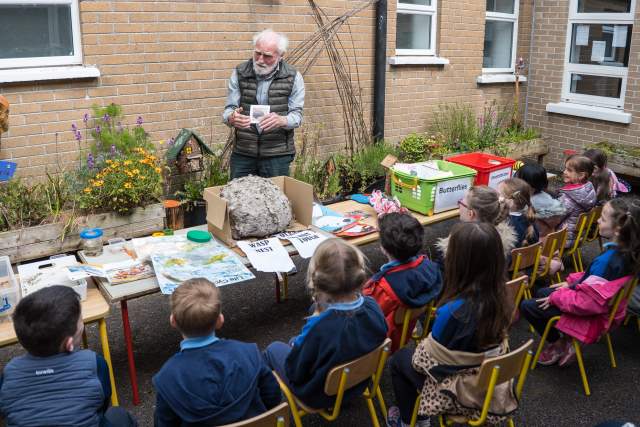
1. Bring the class out to look for robin-run- the-hedge in the hedge or in rough neglected areas. It should be there from April till the end of September. Show how it can stick to its surroundings and indeed to the pupils’ clothes. Gather the seeds when they form and plant in yoghurt pots in the window of the class and watch how quickly they grow as compared to flowers that are desired. Weeds always grow faster to get a competitive edge and this plant can be a scourge in cultivated gardens.