Teachers' Resources | Heritage in Schools Skip to main content

Teachers' Resources

Teach your pupils how to build a giant nest, create a butterfly garden or make their own family tree!

The resources provided here have been submitted by Heritage Experts, teachers or prepared by other educational organisations. The resources are both fun and educational and are designed to inspire and develop an appreciation and curiosity about Ireland’s wonderful natural and cultural heritage.

Resources can be searched for under the following categories:

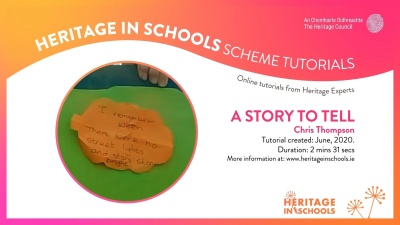
A story to tell: Chris Thompson

Science, History, Geography

Children are encouraged to examine the heritage significance of their immediate environment through familiar local landscape features.

Suited to children from 2nd to 4th class.

The example of an old tree is used in this tutorial. The activity encourages children to consider questions about past, present and future through personification and the creation of an unusual pictorial poem at the same time. The activity can be applied to other local features, a road, an old building etc.

Knitting needles: Ruth Marshall

History

Ruth will show how you can make your own knitting pins - using sticks, a pencil sharpener and a little bit of sandpaper.

Suited to children of all ages.

The lucky well: Mark Wilson

History

An introduction to the history of the traditional Irish farm well.

Suited to children and adults of all ages.

Time travel adventure: Áine Brosnan

History

There are old school houses in most communities so this is a very accessible monument type and this exercise aims to get the children thinking about what was different and what was similar long ago.

Suitable for children from 3rd to 6th class.

How to build an insect hotel: Kay Synott

Science

Kay's tutorial, filmed in a woodland, demonstrates how to build an insect hotel with materials found at home and in a garden or woodland.

Suited to children from 2nd to 6th class

Beetles in my backyard: Nessa Darcy

Science

Learn how to create a pitfall trap in your garden to catch live ground beetles and other invertebrates for a closer look.

Suited to children from 2nd to 6th class.

Dáithí and the Woodlice: Martina Butler

Science

This tutorial shows children how to find nature (Woodlice) in their own back yard. Woodlice can be found in most outdoor locations.

Suited to children of all ages.

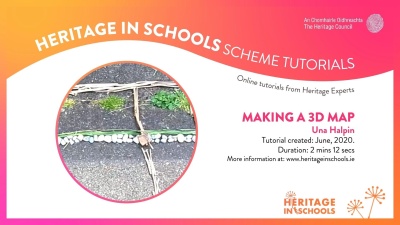
Making a 3D map of your walk: Úna Halpin

Science, Geography

This tutorial encourages children to explore and record their local heritage by taking a walk locally and making a 3D map of what they have seen.

Suited to children of all ages.

Solitary bee hotels: Dale Treadwell

Science

Dale and Nathan show us how to construct a solitary bee hotel from materials you'll find at home.

Suited to children of all ages.

The heritage of hammers: Mark Wilson

History

Mark explains how finding the perfect hammer and learning to use it for its purpose has endless possibilities.

Suited to children of all ages.

The heritage of hats: Mark Wilson

History

By finding everyday items we can learn the heritage of our locality, the tools and items which we can find within our own house holds and the history and use that is attached to them to enhance our learning and future lifestyle.

Suited to children and adults of all ages.

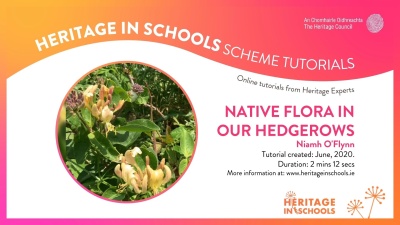
Native flora in our hedgerows: Niamh O'Flynn

Science, Geography

Niamh illustrates some plants from hedgerows: foxglove, herb robert, vetch, honeysuckle, nettles, gorse/ furze, hawthorn at stages of develeopment, decay and reseeding.

Suitable for children from 2nd to 6th class

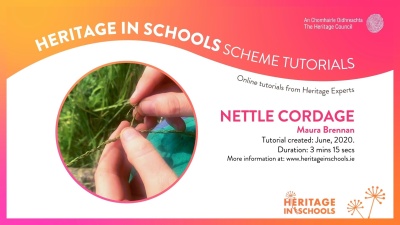
Nettle cordage: Maura Brennan

Science, History, Geography

Discover the natural resources growing near your own doorstep! Learn about sustainable plant fibres as we learn how to process nettles to make cordage.

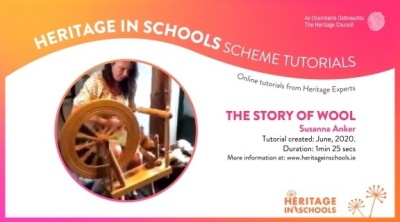
The story of wool: Susanna Anker

Science, History, Geography

Susanna demonstrates the story of wool from carding to spinning to dyeing and weaving.

Suitable for children from 1st to 6th class

All about potatoes: Roisín Cotter

Science

Learning how to grow potatoes is a skill for life and a small step in increasing the sustainability of our everyday lives.

Suited to children from 3rd to 6th class.

Let's hunt for bugs!: Kay Synott

Science

Kay's tutorial, filmed in a garden, shows where to find different invertebrates, how to safely trap and identify them using a pitfall trap.

Suited to children of all ages.

Dáithí at the Rocky Seashore: Martina Butler

Science

This tutorial shows younger children a little about some of the typical species that can be found in rock pools at the rocky sea shore.

Suited to children from junior to 1st classes.


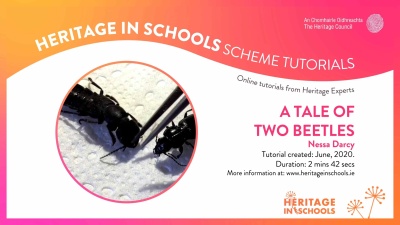
A tale of two beetles: Nessa Darcy

Science, History

Legend has it that two different types of beetle once fought over a juicy slug, but all may not have been as it seemed. Learn about the ecology and anatomy of ground beetles and the devil's coach horse beetle.

Suited to children from 1st to 4th classes.

Making a sugar lure for moths: Albert Nolan

Science

Moths are attracted by the scent of fermenting fruit. You can make up a sugary treat for moths. There are many different recipes and why mot experiment - Albert shares his receipe here.

Gardening for Biodiversity

Science, Geography

A booklet to assist everyone to help wildlife in their gardens. The brainchild of Juanita Browne, the booklet was produced by Laois County Council with the assistance of Local Authority Heritage Officers across Ireland, with support from the National Parks and Wildlife Service and the Heritage Council.

Taking a very practical approach, the book details projects to help wildlife of all kinds under a range of headings, with tasks suitable for everyone from the total beginner to the more ambitious DIY enthusiast. With clear instructions and step-by-step drawings by illustrator Barry Reynolds, the guide offers the gardener lots of options to help our biodiversity.

A colouring book for children using the beautiful garden wildlife illustrations by Barry Reynolds has also been produced.

Protecting Farmland Pollinators: newsletter for farming kids (April 2020)

Science

A pollinator newsletter for children on Protecting Farmland Pollinators. Learn about Pollinator Science, History and Geography with games, puzzles, art and competitions.

Protecting Farmland Pollinators is a European Innovation Partnership (EIP) project funded by the Department of Agriculture, Food and the Marine (DAFM) under the Rural Development Programme 2014-2020. The project is coordinated by the National Biodiversity Data Centre. The National Biodiversity Data Centre is an initiative of the Heritage Council.


Discover the Walled Towns of Ireland: a workbook for primary school children

History, Geography

The Irish Walled Towns Network (IWTN) was formed by the Heritage Council in 2005 to help the walled towns of Ireland become better places in which to live, work and visit. The island of Ireland has 56 known walled towns, 29 of which have joined the IWTN.

A lovely workbook for primary school children introducing them to the the walled towns of Ireland.